Climate Positive
Our climate strategy
Brambles’ 2030 Climate Positive target area aims to achieve Brambles’ science-based targets and respond to climate change impacts through adaptation and mitigation measures. To this end, Brambles’ Climate Strategy comprises a transition plan and an adaptation plan.
Brambles’ approach to climate change is shaped by three themes identified through our climate scenario analysis: lower carbon advantage,1 network capacity and raw material supply. In response, our climate strategy is structured around two complementary elements: climate transition and climate adaptation.
Further details on our approach to climate change can be found in the Climate Update section of the Brambles 2026 Annual Report.
Sustainability Report – Climate UpdateClimate transition plan
Lower carbon advantage
Brambles’ climate transition plan focuses on reducing GHG emissions across our operations and value chain, while seeking to strengthen the lower carbon advantages of our circular business model.1
Brambles is working towards a 1.5°C climate future as contemplated by the 2015 Paris Climate Agreement. Our validated 2030 science-based targets (SBTs) and 2040 net-zero ambition are at the core of our climate transition strategy which is guided by climate science.
Climate adaptation plan
Network capacity
Raw material supply
Brambles recognises that emissions reduction alone is not sufficient. In response, we are working to integrate climate adaptation processes across Brambles’ timber sourcing and service centre network.
Our climate adaptation approach seeks to improve resilience to physical climate risks across our operations and value chain. These risks include storms, flooding, bushfire and extreme heat, which may affect network capacity and raw material supply. To inform adaptation planning, Brambles has assessed the exposure of both Brambles operated and subcontracted locations to severe weather hazards.
1
Brambles considers its business model to be lower carbon intensive relative to single-use alternatives. This is supported by independent LCAs.
Climate transition
In response to the climate-related transition risks and opportunities associated with Brambles’ lower-carbon advantage, Brambles has developed a climate transition plan to reduce GHG emissions across its operations and value chain.
Lower carbon advantage
In response to the climate-related transition risks and opportunities associated with Brambles’ lower-carbon advantage, Brambles has developed a climate transition plan to reduce GHG emissions across its operations and value chain. While Brambles’ circular business model is lower-carbon compared to single-use alternatives, Brambles is taking steps to reduce GHG emissions in the broader supply chain, specifically the logistics and transport sectors.
Brambles’ transition plan is built around four pillars:
- Emissions reductions roadmap: identifying and delivering on decarbonisation opportunities.
- Integration into decision-making: establishing processes, tools and guidance to progressively embed climate considerations into decision-making, creating a low carbon bias.
- Supplier engagement: partnering with Brambles’ suppliers on carbon accounting, target-setting and decarbonisation opportunities.
- Carbon removals:2 defining a strategy that complements the emissions reductions roadmap by addressing residual emissions to reach net-zero.
Transition plan targets:
SBTs to 2030 cover Brambles Scope 1, Scope 2 and certain Scope 3 GHG emissions:
- 42% reduction in absolute Scope 1 and 2 GHG emissions by 2030 (on 2020 levels); and
- 17% reduction in absolute Scope 3 GHG emissions by 2030 (on 2020 levels).
Transition plan to achieve net-zero ambition by 20403
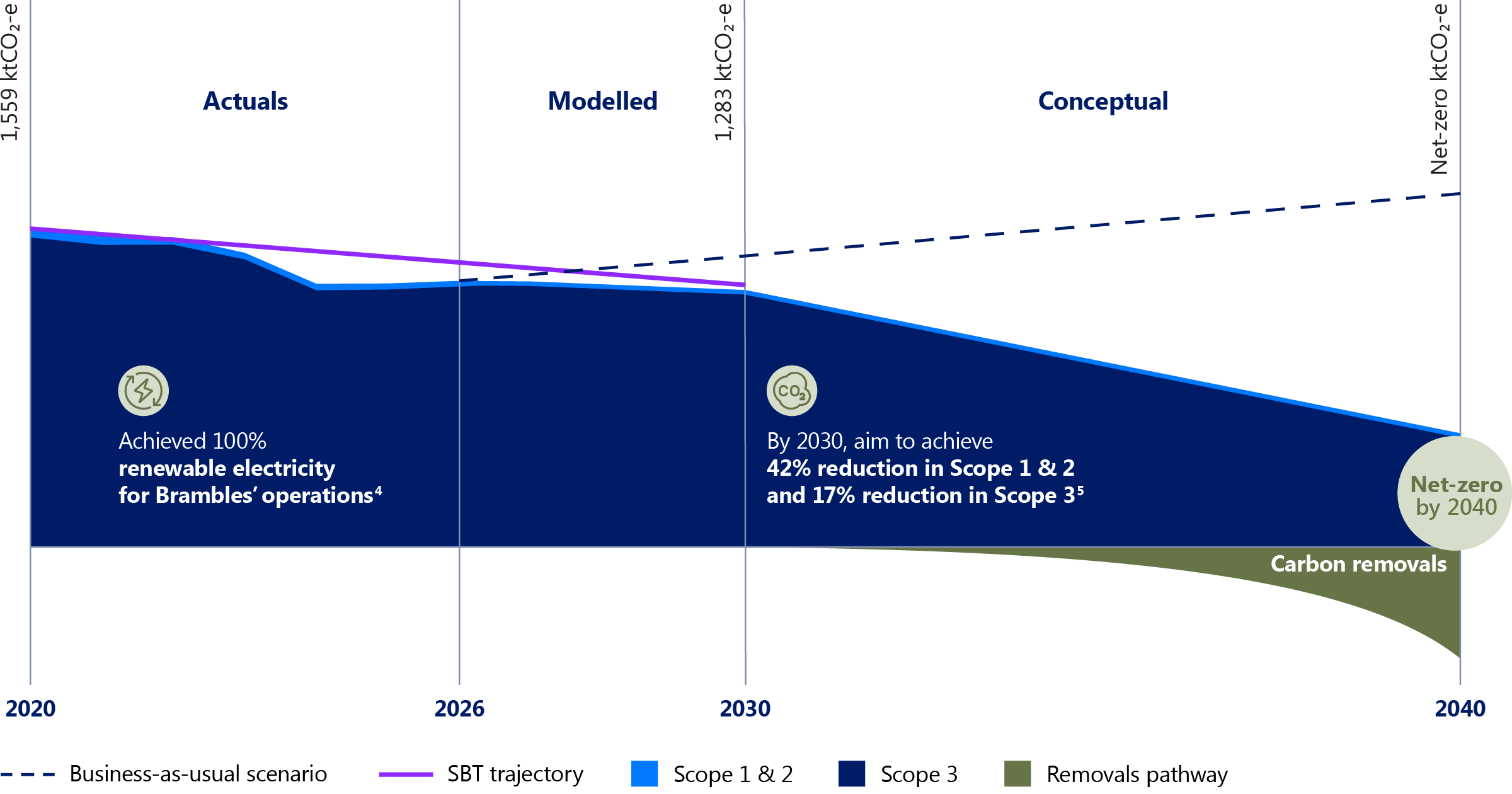
- Carbon removal refers to the process of actively extracting carbon dioxide (CO2) from the atmosphere and storing it permanently.
- Brambles uses Energy Attribute Certificates (EACs) to achieve its renewable electricity target, and Renewable Gas Guarantee of Origin (RGGO) Certificates in relation to Scope 1. In addition, it plans to use carbon removals to achieve its net-zero ambition. Carbon removals refers to the process of actively extracting carbon dioxide (CO2) from the atmosphere and storing it permanently.
- Brambles’ operations refers to locations under Brambles’ operating control (relating to Scope 1 & 2) and excludes third party managed locations.
- SBTs to 2030 cover Scope 1 emissions (net of biogenic emissions and contractual instruments), Scope 2 emissions (calculated using a market-based approach) and certain Scope 3 emissions. The Scope 3 emissions categories within the scope of Brambles’ target are Category 2: Capital goods (related to product materials), Category 4: Upstream transportation & distribution, Category 5: Waste generated in operations, Category 9: Downstream transport & distribution and Category 10: Processing of sold products (related subcontracted service centres).
Climate adaptation
Complementing the climate transition plan, Brambles’ climate adaptation plan addresses the physical climate-related risks associated with network capacity and raw material supply, setting out the actions Brambles is taking to enhance resilience across its operations and value chain.
Network capacity
A climate-resilient network can help reduce the operational and financial impacts of severe weather and other climate‑related disruptions. Brambles’ network capacity is supported by the scale of our service centre network, our reusable asset pool, repair and reconditioning systems, digital platforms, transport carrier relationships and the experience of our workforce operating in complex supply chains.
Network capacity target:
- Maintain 100% screening of Brambles operated and subcontracted locations for vulnerability to severe weather events.
Brambles’ network capacity plan consists of three phases
Phase 1: completed
Map severe weather hazards across Brambles operated and subcontracted locations and linked findings to business continuity
Phase 2: in progress
Embed climate considerations into core processes (e.g. plant network optimisation, real estate, building and equipment design)
Phase 3: commencing FY27
Establish a roadmap for integrating climate resilience into broader organisational processes
Raw material supply
Brambles aims to strengthen resilience across our raw material supply, particularly timber, which may be affected by acute weather events and longer-term changes in forest productivity. Our approach focuses on maintaining diversified and sustainably certified timber sourcing options across geographies, suppliers and timber species, while also reducing reliance on new timber through product design, asset recovery and asset productivity initiatives.
Through our Forest Positive target area, Brambles is leveraging nature-based solutions for resilience to climate events and continues to explore alternative timber species, assessing options that may support long-term supply resilience.
Raw material supply targets:
- Maintain 100% sustainably certified timber sourcing; and
- Maintain at least 90% training completion on Brambles’ Climate Risk Screening Tool for timber procurement professionals.
Nature Positive in action
Featured projects illustrating our efforts under our Nature Positive Programme